


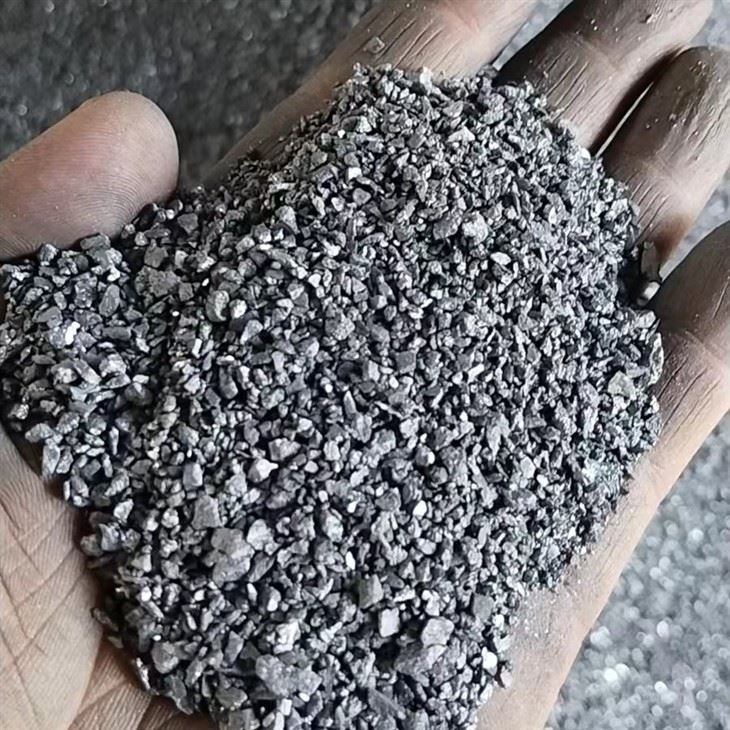
High Purity Silicon Metal Granules
Overview
Premium Silicon Granules for Semiconductor, Solar (PV), Advanced Electronics, and High-Performance Alloys
Our High-Purity Silicon Metal Granules are produced from selected silicon metal feedstock and processed through controlled purification and mechanical sizing steps. The material is designed for use in automated production environments, providing stable flow behavior and reducing issues commonly seen with irregular silicon chunks or fine powders, such as dust generation, feeding interruption, and inconsistent melting behavior.
With impurity levels controlled at ppm (parts per million) scale, the material is designed to support stable processing conditions, consistent thermal behavior, and improved yield in crystal growth and thin-film related applications.
Technical Specifications
To align with industrial requirements, trace element control is evaluated using GDMS (Glow Discharge Mass Spectrometry) and ICP-MS analytical methods.
|
Grade |
Si Content (Min) |
Key Impurities Controlled (Max Individual / Total) |
Primary Application |
|
5N Grade |
99.999% |
Fe ≤ 2 ppm, Al ≤ 1.5 ppm, Ca ≤ 1 ppm |
Semiconductor crystal growth, CZ/CCz processes, optoelectronics |
|
4N5 Grade |
99.995% |
Fe ≤ 10 ppm, Al ≤ 5 ppm, Ca ≤ 3 ppm |
Solar cells, thin-film deposition, target materials |
|
4N Grade |
99.99% |
Fe ≤ 50 ppm, Al ≤ 20 ppm, Ca ≤ 10 ppm |
Specialty alloys, electronic ceramics, battery-related materials |
Note: Elements such as Boron (B), Phosphorus (P), and Titanium (Ti) are monitored and can be adjusted according to customer-specific requirements.
Features and Benefits
Standard Particle Size Distribution (PSD)
Particle size is controlled through multi-stage screening to maintain a stable distribution curve. This helps reduce uneven melting behavior caused by oversized particles and minimizes dust generation from excessive fines.
Ultra-Fine Feeding Grade: 0.1 – 0.3 mm / 0.3 – 0.5 mm
Standard Automated Grade: 0.5 – 1.0 mm / 1.0 – 3.0 mm
Heavy-Duty Melt Grade: 3.0 – 5.0 mm
Optimizing Automated Continuous Feeding (CCz)
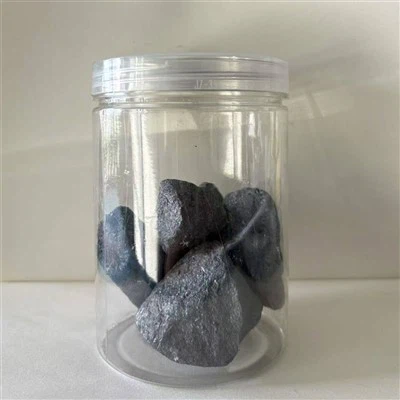
Compared with irregular silicon lumps that may cause bridging in hoppers, or fine powders that can block vacuum conveying systems, the granule morphology supports more stable bulk flow and feeding behavior. This improves consistency in Continuous Czochralski (CCz) crystal growth systems and related automated feeding processes.
Contamination Control & Yield Stability
Elements such as Iron (Fe) and Copper (Cu) can affect semiconductor and solar cell performance by introducing recombination centers. To reduce contamination risk, the material is processed under controlled conditions with equipment designed to minimize metal contact during crushing and sizing stages.
Typical Applications
Semiconductor Manufacturing
High purity silicon granules are widely used as raw materials in semiconductor-related manufacturing processes where impurity control is critical.
Typical applications include:
• Crystal growth
• Silicon wafer production
• Electronic-grade silicon materials
• Semiconductor research
Solar and Photovoltaic Industry
Silicon purity directly affects polysilicon processing and photovoltaic material performance.
Our granules are suitable for:
• Polysilicon production
• Solar cell manufacturing
• Photovoltaic material research
Solar and Photovoltaic Industry
Silicon purity directly affects polysilicon processing and photovoltaic material performance.
Our granules are suitable for:
• Polysilicon production
• Solar cell manufacturing
• Photovoltaic material research
Metallurgical Applications
For specialty alloy production, controlled silicon composition helps improve alloy quality and production consistency.
Applications include:
• High-performance aluminum alloys
• Specialty metallurgical materials
• Precision casting materials
Scientific Research
Research institutes and laboratories often require small quantities of high purity materials with documented chemical composition.
Our silicon granules are supplied for:
• Material science research
• University laboratories
• New material development
• Process validation
Quality Assurance & Compliance
We operate under a structured quality management system to support traceability and audit requirements:
Quality System: ISO 9001:2015 compliant.
Traceability: Each lot is issued with a Certificate of Analysis (COA) based on GDMS/ICP-MS testing. Retained samples are stored for 24 months.
Packaging: Multi-layer packaging including vacuum-sealed aluminum foil bags, packed in steel or fiber drums to reduce moisture and oxidation during transport.
Certificate


FAQ
Q: What analytical methods are used for 4N/5N purity verification?
A: Each batch is tested using ICP-OES for 4N grades. For higher purity grades (4N5 and 5N), GDMS or ICP-MS is used to detect trace elements at ppm/ppb levels. The COA includes both metallic (Fe, Al, Ca, Mg, Ti) and non-metallic elements (B, P).
Q: How is cross-contamination controlled during processing?
A: To reduce contamination from mechanical wear, equipment in contact with material is designed with silicon-compatible or coated surfaces. Metal-contact exposure is minimized. After processing, materials may undergo cleaning and drying steps to reduce surface residues.
Q: Are the granules suitable for CCz feeding systems?
A: Yes. The 0.5–1.0 mm and 1.0–3.0 mm size ranges are commonly used in automated CCz feeding systems. The particle shape and size distribution are designed to support steady feeding without frequent blockage in transfer lines.
Q: What are typical limits for Boron (B) and Phosphorus (P)?
A: For standard grades, Boron is typically controlled below 0.5–1.0 ppmw, and Phosphorus below 1.0–2.0 ppmw. Lower thresholds can be achieved upon request depending on application requirements.
Q: Can particle size distribution be customized?
A: Yes. PSD can be adjusted based on application requirements. Fine particle content can be controlled, with typical specifications limiting particles below 100 microns to less than 1% or 0.5%, verified by laser diffraction analysis.
Q: What is the typical lead time and sample availability?
A: Samples (1–25 kg) can be shipped by air within 3–5 working days. Bulk orders usually require 15–25 days depending on specifications and packaging requirements. Export documents including COA, SDS, and shipping paperwork are provided with each shipment.
RFQ: Request a Technical & Commercial Quotation
To evaluate your requirements and provide a quotation, please include:
• Target purity grade (4N / 4N5 / 5N or ppm requirements)
• Required particle size distribution (PSD)
• Application details (e.g., CCz crystal growth, semiconductor, thin film)
• Order volume and delivery schedule
• Incoterms and destination country (e.g., FOB Qingdao, CIF Rotterdam)
Hot Tags: high purity silicon metal granules, China high purity silicon metal granules manufacturers, suppliers, factory, High Density Silicon Metal Granules, High Purity Silicon Granules, High Purity Silicon Metal 99 99 , Industrial Silicon Metal Granules, pure silicon metal, Silicon Metal Lump 2202 Grade
Next
No InformationYou Might Also Like



Send Inquiry