


Silicon Metal Granules
Industrial Silicon Metal Granules Factory | Flow Particles for Al-Si Alloys Casting
We are a direct industrial manufacturer specializing in the precision crushing, magnetic separation, and screening of high-purity Silicon Metal Granules. Our processing lines are engineered specifically to eliminate handling loss, prevent hopper bridging, and optimize dosing accuracy in fully automated continuous feeding lines.
Available Grades
Standard metallurgical and chemical specs (Equivalent to 553, 441, 3303, 2202 localized sizing).
Physical Engineering
Tailored Bulk Density ($1.2 - 1.4\ g/cm^3$) and controlled particle size distribution (PSD).
Production Capacity
3,500 MT Monthly Crushing & Screening Output.
Compliance Protocol
Full ISO 9001:2015 registration, REACH compliant, and third-party certified (SGS / Bureau Veritas).


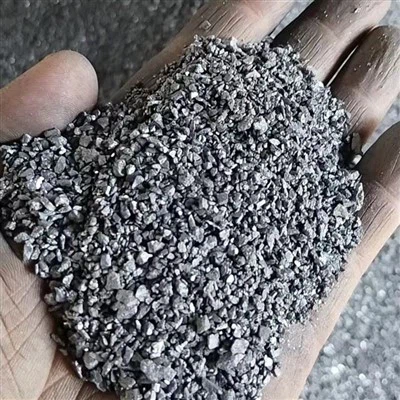
Advantage of Silicon Metal Granules
Eliminating Automated Feeding Jams: Uneven lumps cause bridging and ratholing in automated day-bins. Our flow-optimized granules ensure continuous, uninterrupted gravimetric or volumetric dosing.
Drastic Reduction in Material Yield Loss: Manual crushing of lumps on foundry floors generates up to 5% – 8% fine dust waste. Granules arrive pre-sized, driving mineral recovery rates close to 98%.
Homogeneous Melting Kinetics: Large lumps cause local temperature drops and uneven dissolution paths in melt baths. Granules provide a high surface-area-to-volume ratio, ensuring rapid, uniform alloy integration.
Mitigating EAF & Ladle Dust Emissions: Fine silicon dust is a severe health hazard and clogs plant baghouse filters. Our multi-stage dust extraction process ensures minimal fines (< 0.5% under-size).
Lower rejection rates in aluminum casting: Inconsistent silicon dissolution can lead to hard spots or micro-segregation in structural castings (such as automotive wheels). Precision granules ensure stable and predictable silicon (Si) recovery in every batch, supporting consistent metallurgical performance.
TECHNICAL SPECIFICATIONS & MATERIAL GRADES
|
Grade Standard |
Silicon (Si) Min % |
Iron (Fe) Max % |
Aluminum (Al) Max % |
Calcium (Ca) Max % |
Typical Industrial Use-Case |
|
Granular 553 |
98.5% |
0.5% |
0.5% |
0.3% |
Secondary Al-Si Alloys (ADC12, LM24) |
|
Granular 441 |
99.0% |
0.4% |
0.4% |
0.1% |
Structural Auto Components (A356, A380) |
|
Granular 3303 |
99.3% |
0.3% |
0.3% |
0.03% |
Special Metallurgy & Steel Deoxidation |
|
High-Purity Chemical |
99.5% - 99.9% |
≤ 0.15% |
≤ 0.15% |
≤ 0.02% |
Silicone Monomers & Organosilicon Feedstock |
Controlled Physical Parameters
|
Bulk Density |
1.20 – 1.45 g/cm³ (depending on particle size distribution) |
|
Angle of Repose |
≤ 35° (optimized for stable silo discharge and excellent flowability) |
|
Trace Contamination |
Free from slag inclusions, visible moisture, and foreign organic matter |
Precision Particle Size Distribution
We operate high-frequency vibrating screening systems to separate highly precise particle fractions:
Micro-Granules: 1–3 mm / 1–5 mm (ideal for rapid reaction in ladle deoxidation processes)
Standard Granules: 2–8 mm / 3–10 mm (optimized for chemical fluidized-bed reactors and aluminum dosing applications)
Coarse Granules: 10–30 mm (designed for coreless induction furnace charging)
Custom particle size distribution curves can be tailored to match specific mesh requirements and plant process conditions.

INDUSTRIAL APPLICATION MATRIX
Automotive & Primary Aluminum Alloys
Granules are fed directly into holding furnaces or inline rotor degassing systems to precisely adjust silicon content in structural alloys. This ensures tight compliance with international standards like EN BD102 or ASTM B179.
Ladle Steel Refining & Deoxidation
In steelmaking, granulated silicon serves as a powerful deoxidizing agent in liquid steel. Its predictable sizing allows steelmakers to hit narrow carbon/silicon specification windows in the Ladle Furnace (LF) without introducing unexpected slag variance.
Organosilicon & Silicone Syntheses
Used in fluid-bed reactors via the Direct Synthesis method to produce methyl chlorosilanes. The uniform granule size maintains ideal fluidization velocity, avoiding bed channelization while maximizing chemical yield.
PROCESS ARCHITECTURE & QUALITY GATEKEEPING
How We Ensure Batch-to-Batch Replicability:
[Metallurgical Base Ingot Verification] ➔ [Primary Low-Friction Jaw Crushing] ➔ [Multi-Deck Vibrating Screening] ➔ [Dual-Stage High-Intensity Magnetic Separation] ➔ [ICP-OES Sampling] ➔[Integrated Sealed Packaging]
Critical Quality Control Points
Ingot Sourcing Vetting: We do not use scrap or uncontrolled floor-drippings. Our input feed consists exclusively of certified primary silicon blocks.
Advanced Magnetic Separation: Industrial crushing inevitably introduces trace iron wear particles. We pass all granules through a 12,000 Gauss dual-stage rare-earth magnetic separator to strip out mechanical $Fe$ contamination.
Sieve Integrity Audits: Screen mesh wear is checked every 8 operating hours via laser diffraction particle size analysis to prevent oversized or undersized leaks.


LOGISTICS & PACKAGING
Standard Export Units
1,000 kg or 1,250 kg UN-Rated Heavy-Duty Jumbo Bags (Polypropylene, UV-stabilized, with cross-corner loops and a bottom discharge spout).
All jumbo bags include a 100-micron internal PE liner hermetically sealed to block moisture ingress.
25 kg multi-wall paper/plastic bags stacked, strapped, and shrink-wrapped on ISPM-15 heat-treated fumigated wooden pallets.
Container Optimization
Standard 20GP container loading maxed out safely at 25 to 27 Metric Tons with protective floor cardboard and desiccant poles.
FAQ
COMMERCIAL RFQ PROFILE
To enable our technical engineering department to issue an actionable commercial proposal and allocate production capacity, please specify your parameters:
Target Chemical Grade or Max Impurities
(E.g., Si 99.0% Min, Fe 0.4% Max)
01
Required Particle Size Distribution Scope
(E.g., 2–6 mm, 3–10 mm)
02
Monthly / Annual Tonnage Commitment
(Metric Tons)
03
Incoterms & Destination Port
(E.g., CIF Rotterdam, FOB Tianjin, CFR Santos)
04
Unloading Automation Infrastructure
(E.g., Silo pneumatic feed, Hopper gravimetric dump)
05