


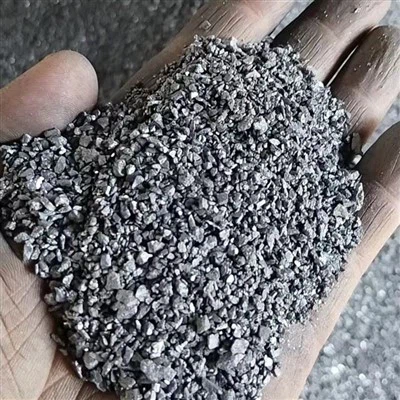
Low Iron Silicon Metal Granules
In safety-critical aluminum casting systems, iron is not a passive impurity. Even small variations in Fe content can affect fatigue resistance, elongation, and overall structural stability.
Overview
High-Consistency Metallurgical Additive for Automotive-Grade & Aerospace Aluminum Alloys
Premium Low-Iron Silicon Metal Granules are designed for high-end casting facilities, primary aluminum smelters, and alloy producers where iron (Fe) control is a critical process parameter.
In safety-critical aluminum casting systems, iron is not a passive impurity. Even small variations in Fe content can affect fatigue resistance, elongation, and overall structural stability.
This product is developed for production environments where batch-to-batch consistency of iron content is more important than nominal purity values alone.
Technical Specification Matrix
|
Element |
Premium Grade 3303 |
Ultra-Low Fe Grade (Custom) |
Metallurgical Impact |
|
Silicon (Si) |
≥ 99.30% |
≥ 99.50% |
Improves recovery efficiency and reduces melt consumption |
|
Iron (Fe) |
≤ 0.30% |
0.15%–0.20% |
Controls formation of brittle intermetallic phases |
|
Aluminum (Al) |
≤ 0.30% |
≤ 0.15% |
Maintains eutectic stability in aluminum alloys |
|
Calcium (Ca) |
≤ 0.03% |
≤ 0.02% |
Reduces slag formation and refractory wear |
Trace elements such as Ti, Mn, and P can be controlled under customized technical requirements. Each batch is tested via ICP-OES and XRF according to standard industrial methods.
Iron Contamination Control System
Achieving stable low iron levels requires process-level control rather than post-sorting.
Source control
Quartz raw materials are selected with high SiO₂ content (≥99.7%) and stable baseline impurity levels. Low-ash reductants are used to reduce external contamination during smelting.
Magnetic separation
After crushing, materials pass through dual-stage high-gradient magnetic separators (≥12,000 Gauss) to remove free iron introduced during mechanical processing.
Batch segregation
Each furnace tap is treated as an independent production lot. No blending is used to adjust chemical averages.
Particle Size Distribution (PSD) for Industrial Feeding
Granule size directly affects melting behavior and feeding stability in automated systems.
• 1–3 mm: Fast melting and chemical reaction applications
• 3–10 mm: Pneumatic feeding and continuous dosing systems
• 10–50 mm: Furnace charging and large-scale melting
Fine particle control
A vacuum air-classification system is used after crushing to control fines (≤0.5 mm) within 5% by weight.
This helps reduce:
• Dust loss during furnace charging
• Feeding instability in pneumatic systems
• Material bridging in hoppers
Quality Control & Compliance System
Production follows a controlled industrial workflow:
Quartz sourcing → Arc smelting → Ladle refining → Crushing → Magnetic separation → Screening → Laboratory testing
Key controls
• No blending of furnace batches
• Controlled raw material input
• Full separation of production lots
• Final laboratory verification before release
Each batch is independently validated using ICP-OES testing.
Certificate


Traceability & Inspection Support
Each jumbo bag includes a serialized barcode linked to:
Furnace tap record
Raw material source
Chemical analysis results
Particle size distribution data
Retained samples are stored for up to 24 months for verification.
Third-party inspection (SGS / BV / TÜV) is available upon request.
Packaging & Logistics
Designed for long-distance sea freight and industrial handling:
1,000 kg / 1,250 kg jumbo bags
Inner PE moisture barrier liner
UV-resistant woven PP outer layer
ISPM-15 certified wooden pallets
Reinforced strapping for container stability
FAQ
Q: What international grades does this material correspond to?
A: Typically Grade 3303, or customized low-iron variants such as 2202 depending on Fe requirements. Custom specifications can be produced upon request.
Q: How do you control mechanical iron contamination?
A: After crushing, materials pass through dual-stage high-gradient magnetic separation systems to remove free iron introduced during processing.
Q: Why is calcium control important in low-iron silicon?
A: Calcium affects slag behavior and can influence refractory wear and inclusion formation in aluminum casting systems. Lower calcium improves process stability.
Q: How do you ensure stable feeding in pneumatic systems?
A: We control fine particle content through screening and vacuum air classification, and use moisture-resistant packaging to maintain flowability.
Q: How is quality dispute handled?
A: Each batch has retained samples stored for verification. If discrepancies occur, results can be cross-checked with retained samples or verified via third-party inspection agencies.
Commercial RFQ Checklist
To prepare a technical and commercial quotation, please provide:
• Required chemical grade (553 / 441 / 3303 or custom specification)
• Particle size range (e.g., 1–3 mm, 3–10 mm)
• Application type (aluminum alloying, steel deoxidation, chemical use)
• Estimated volume (trial + annual consumption)
• Preferred Incoterms and destination port
Hot Tags: low iron silicon metal granules, China low iron silicon metal granules manufacturers, suppliers, factory, High Purity Silicon 50 100mm, High Purity Silicon Metallurgical Grade, Low Iron Silicon Metal, Screened Metallurgical Silicon Metal, si metal, Silicon Metal Lump 50 100mm
Previous
No InformationYou Might Also Like


Send Inquiry