


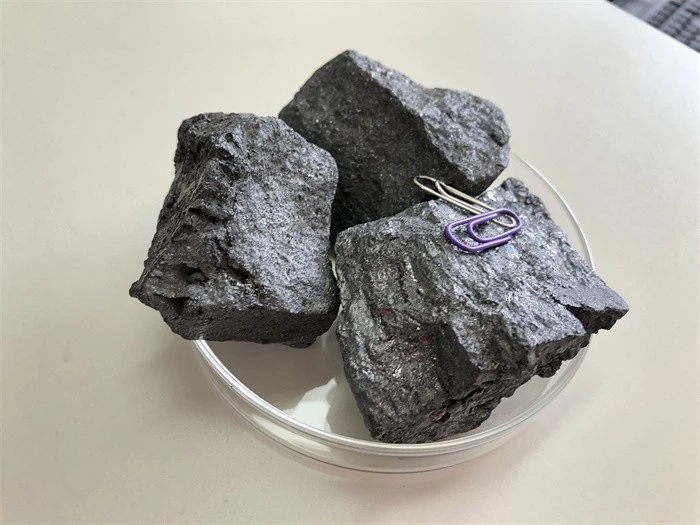
Low Carbon Inoculant Ferro Silicon
Unlike conventional ferrosilicon, this grade is produced with tightly controlled low carbon chemistry and impurity elements to support more predictable metallurgical behavior in modern high-efficiency foundries, especially those using automated pouring systems or thin-wall casting designs.
Product Overview
Low Carbon Inoculant Ferro Silicon is a specially engineered inoculation material used in grey iron and ductile iron casting to control graphite nucleation during solidification.
Unlike conventional ferrosilicon, this grade is produced with tightly controlled low carbon chemistry and impurity elements to support more predictable metallurgical behavior in modern high-efficiency foundries, especially those using automated pouring systems or thin-wall casting designs.
It is commonly selected when foundries experience inconsistent graphite structure, carbide formation, or unstable mechanical properties across production batches.
Chemical Composition
|
Element |
Standard Si75 Grade |
Low Al / Ca Controlled Grade |
Ultra-Low Carbon Grade |
|
Silicon (Si) |
72.0–78.0% |
74.0–78.0% |
75.0–80.0% |
|
Carbon (C) |
≤0.10% |
≤0.05% |
≤0.02% |
|
Aluminum (Al) |
0.8–1.5% |
≤0.5% |
0.5–1.2% |
|
Calcium (Ca) |
0.5–1.0% |
0.3–0.8% |
0.6–1.2% |
|
Sulfur (S) |
≤0.02% |
≤0.015% |
≤0.015% |
|
Phosphorus (P) |
≤0.03% |
≤0.025% |
≤0.025% |
Standard ferrosilicon inoculants often contain 0.2–0.5% carbon. In thin-wall castings or high cooling-rate molds, this variation can slightly shift the solidification equilibrium, increasing the risk of localized carbide formation.
By reducing carbon to ≤0.05% or lower, the inoculant minimizes unintended carbon contribution to the melt, allowing the base iron carbon equivalent (CE) to remain stable.
Technical Characteristics
Controlled low carbon content: Reduces interference with silicon-driven nucleation during solidification.
High active silicon phase stability: Ensures effective dissolution in molten iron without excessive fade loss.
Optimized particle size distribution (customizable): Improves contact efficiency between inoculant particles and molten iron.
Low impurity interference elements (S, P, excess Al control): Reduces unwanted nucleation disturbances that affect graphite morphology.
Stable inoculation retention time ("fade resistance"): Maintains effectiveness long enough for typical ladle-to-pour cycles in industrial casting lines.
Application Areas
This grade is typically used in foundries producing components with strict mechanical or dimensional requirements:
Engine blocks, cylinder heads, brake discs
Gearbox housings, pump bodies, valve casings
Structural hubs and bearing housings
Cast iron beds requiring vibration damping and stability
It is particularly relevant for IATF 16949-certified suppliers and export-oriented foundries serving OEM customers.
Particle Size Options & Addition Practice
Inoculation efficiency depends not only on chemistry but also on particle size and addition timing.
Available size ranges:
• Ladle inoculation: 1–3 mm / 3–8 mm
• In-stream inoculation: 0.2–0.7 mm / 0.5–1.0 mm
• Cored wire powder: 0.2–1.0 mm
Practical guidance:
• Early ladle addition improves dissolution stability
• Late stream inoculation helps reduce fade in automated casting lines
• Fine powder grades are used where rapid nucleation is required in short pouring cycles
Fines content is controlled below 5% to reduce oxidation loss during handling.
Quality Control & Traceability
To ensure consistent industrial performance, each batch is controlled under the following procedures:
Spectrometric testing (Si, Al, Ca, trace elements)
Furnace heat traceability linked to production logs
Controlled impurity screening (Sb, Ti, Bi, As, Ce)
Batch-level QR/barcode tracking for shipment identification
Material Test Report (MTR) issued per shipment
This traceability system is designed to support OEM procurement requirements and quality audits.
Certificate


Packaging & Export Handling
25kg moisture-resistant laminated bags
1MT / 1.25MT jumbo bags with UV protection
Optional vacuum-sealed packaging for long sea transport
Controlled storage to reduce oxidation of active Ca/Al elements
FAQ
Q: What is the main difference between low carbon inoculant FeSi and standard FeSi?
A: Low carbon inoculant FeSi contains significantly lower carbon content, which reduces unintended carbon contribution to molten iron. This helps maintain a stable carbon equivalent (CE) in the base iron, especially in thin-wall or fast-cooling castings.
Q: Why is carbon content important in inoculation?
A: Excess carbon can slightly shift the solidification behavior of molten iron. In some casting conditions, this may increase carbide formation or cause uneven graphite distribution.
Q: Can this product improve ductile iron nodule count?
A: In many production environments, improved nucleation behavior leads to higher and more stable nodule counts, but final results also depend on base iron chemistry and treatment process.
Q: What particle size should I choose?
A: Coarser sizes (3–8 mm) are generally used for ladle inoculation, while fine powders (0.2–0.7 mm) are better for in-stream or automated pouring systems.
Q: Does this product eliminate casting defects completely?
A: No inoculant can eliminate defects alone. However, it can significantly reduce risks related to nucleation instability when used correctly within a controlled casting process.
Q: How long is the inoculation effect active?
A: In typical foundry conditions, the active nucleation window is approximately 10–15 minutes, depending on temperature and addition method.
Q: Can it be used in automated pouring systems?
A: Yes, fine-grade materials are specifically designed for in-stream inoculation in automated or semi-automated casting lines.
Hot Tags: low carbon inoculant ferro silicon, China low carbon inoculant ferro silicon manufacturers, suppliers, factory, Crushed Ferro Silicon, Crushed Ferro Silicon Briquette, Ferro Silicon Granules, ferro silicon industry, Ferro Silicon Lump for Foundry, ferro silicon per ton
You Might Also Like


Send Inquiry