


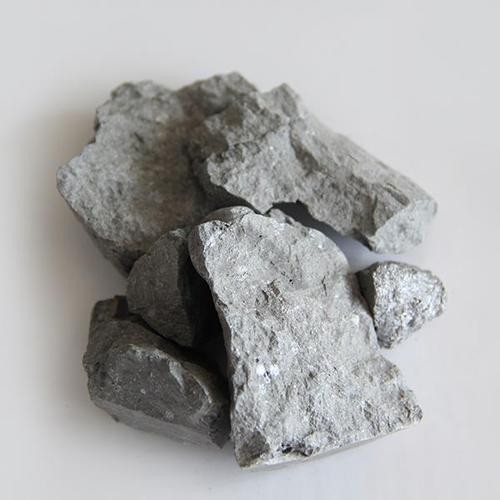
Silicon Metal Lump 3303 Grade
It is positioned between standard 441 Grade and higher-purity grades such as 2202, offering a controlled balance of chemical stability, impurity limitation, and cost efficiency for large-scale industrial use.
Overview
Silicon Metal 3303 Grade is a metallurgical-grade industrial silicon designed for mid-to-high-end aluminum alloy casting and silicone chemical production.
It is positioned between standard 441 Grade and higher-purity grades such as 2202, offering a controlled balance of chemical stability, impurity limitation, and cost efficiency for large-scale industrial use.
Unlike semiconductor or photovoltaic-grade silicon, 3303 Grade is optimized for continuous melting operations, aluminum alloy consistency, and chemical process stability, where operational reliability is more important than ultra-high purity.
Chemical Composition & Technical Specification
Production is carried out in submerged Electric Arc Furnaces (EAF), followed by controlled refining and batch-level chemical stabilization.
|
Element |
Specification |
Typical Analysis |
Industrial Function |
|
Silicon (Si) |
≥ 99.30% |
99.38% – 99.45% |
Ensures stable alloy formation and silicon-phase distribution |
|
Iron (Fe) |
≤ 0.30% |
0.24% – 0.27% |
Reduces brittle β-Al5FeSi intermetallic formation |
|
Aluminum (Al) |
≤ 0.30% |
0.20% – 0.25% |
Controls oxidation behavior and melt stability |
|
Calcium (Ca) |
≤ 0.03% – 0.05% |
0.02% – 0.03% |
Minimizes slag formation and improves furnace efficiency |
Trace elements such as P and B are monitored using ICP-OES and XRF systems to ensure consistency across batches.
Key Value for Industrial Procurement
Improving Structural Integrity in Aluminum Casting
Higher Fe content in lower grades often leads to brittle intermetallic phases, affecting mechanical strength in final cast products.
3303 Grade, with controlled Fe ≤ 0.30%, helps:
• Improve impact resistance
• Reduce micro-cracking risk
• Stabilize solidification structure in aluminum alloys
It is commonly used in structural and load-bearing aluminum components.
Reducing Over-Spec Material Cost
In many procurement systems, higher-grade silicon is used even when not technically required.
3303 Grade provides:
• Sufficient purity for most industrial aluminum alloys
• Lower raw material cost compared to ultra-high purity grades
• Better cost-per-ton performance in continuous production
It is widely used in ADC series and 6000-series aluminum alloys where ultra-high purity is not required.
Improving Furnace Efficiency and Stability
Unstable impurity levels, especially calcium fluctuations, can increase slag formation and energy consumption.
With controlled Ca ≤ 0.03–0.05%, 3303 Grade helps:
• Reduce slag volume
• Improve melting efficiency
• Lower energy consumption per ton of aluminum
Application Areas
Aluminum Alloy Manufacturing (Primary Use)
3303 Grade is widely used in secondary aluminum and foundry operations.
It improves:
• Casting fluidity
• Dimensional stability
• Mechanical uniformity
Typical applications include:
• Automotive components
• Structural aluminum profiles
• Die-cast industrial parts (ADC12, A356, AlSi10Mg)
Silicone Chemical Industry
Used as a raw material in the Rochow process for producing chlorosilanes.
These are further processed into:
• Silicone oil
• Silicone rubber (RTV / HTV)
• Silicone resins for sealing, insulation, and coating applications
Metallurgical Applications
Acts as:
• Deoxidizing agent in steelmaking
• Alloy modifier in non-ferrous metallurgy
• Grain structure regulator in casting processes
Packaging & Export Logistics
Final Solution
Packaging
1 MT / 1.25 MT jumbo bags
UV-resistant woven polypropylene (PP)
Internal moisture-proof PE liner
Reinforced lifting system for bulk handling
Loading capacity
20–27 MT per 20' FCL container
Moisture Control
Material is stored in dry, covered warehouses before shipment. Packaging is designed to prevent moisture absorption and reduce furnace safety risks such as spitting during melting.
Quality Assurance & Traceability
Each batch of Silicon Metal 3303 is controlled through a full traceability system:
Furnace Heat Number tracking (EAF production batch)
XRF chemical analysis
ICP-OES trace element verification
ISO 9001 quality management system compliance
Each shipment includes:
Mill Test Certificate (EN 10204 3.1)
Certificate of Analysis (COA)
Safety Data Sheet (SDS)
REACH compliance documentation (EU shipments)
Certificate


Procurement Positioning in Global Market
Q: When should a procurement team upgrade from 441 Grade to 3303 Grade?
A: The decision hinges entirely on your finished product's mechanical and surface requirements. If your foundry is producing non-structural parts, commercial grade wheels, or basic die-cast components (e.g., ADC12), 441 grade is perfectly cost-effective. However, if you are casting thin-walled structural EV components, high-elongation structural subframes, or products requiring fine anodized polishing, you must upgrade to 3303 Grade.
The lower Iron (≤ 0.3%) and low Calcium (≤ 0.03%) prevent micro-porosity and brittle phases that cause parts to fail strict X-ray or tensile inspections.
Q: How do you prevent chemical segregation between the bottom and top zones of a 1.25-ton jumbo bag?
A:Heavy metalloids like silicon are prone to gravity-induced stratification during transit vibrations if sizing is inconsistent. We mitigate this through two distinct engineering steps: first, we employ dual-stage crushing and strict mechanical sorting to ensure a narrow particle size distribution, preventing small pieces from settling to the bottom. Second, our bagging stations utilize synchronous vibratory compacting beds during filling to lock the lumps into a uniform, homogenized dense pack before sealing.
Q: What precise testing methodologies do you use to issue your EN 10204 3.1 Mill Test Certificates?
A: We do not rely on spot-checking or estimations. Sampling is executed in strict accordance with ISO 3713 metallurgical sampling guidelines.
Chemical analysis is conducted via dual verification:
• Primary: Automated X-ray Fluorescence (XRF) spectrometers
• Secondary: ICP-OES (Inductively Coupled Plasma Optical Emission Spectrometry) for trace elements such as Ca, P, B, and Ti
Sourcing managers may also mandate third-party inspection agencies (SGS, Bureau Veritas) to verify lab records before shipment.
Q: We operate an automated furnace charging line; how do you guarantee that fines (<10 mm) do not increase during maritime transit?
A: We understand that high fines can block automated conveyor systems and cause material loss during furnace charging.
To control this risk, we use:
• Double-layer woven jumbo bags
• High tensile safety rating (5:1 or 6:1 SWL)
• Strict drop-height control (max 1.5 meters) during loading and stuffing
This ensures fines remain within acceptable limits (guaranteed below 5%) upon arrival.
Q: Is your Silicon Metal 3303 Grade fully compliant with EU REACH regulations, and can you support custom long-term price hedging?
A: Yes. We hold valid EU REACH registrations and provide official OR (Only Representative) documentation for smooth customs clearance across EU ports.
For long-term buyers, we offer structured pricing agreements (quarterly or bi-annual) supported by raw material inventory hedging, helping reduce exposure to market volatility, shipping bottlenecks, and energy cost fluctuations.
Conclusion
Silicon Metal Lump 3303 Grade is engineered for industrial users who prioritize stable production performance, controlled impurity levels, and cost efficiency in large-scale aluminum and chemical manufacturing.
It delivers reliable metallurgical behavior suitable for continuous furnace operations where consistency and operational efficiency are critical.
Hot Tags: silicon metal lump 3303 grade, China silicon metal lump 3303 grade manufacturers, suppliers, factory, Crushed Chemical Silicon Metal, High Purity Silicon for Semiconductor Industry, Industrial Silicon Metal Granules, Low Iron Silicon Metal, silicon is it a metal, Solar Grade Silicon Metal
You Might Also Like


Send Inquiry